Qwen3 0.6B · live
live4-bit · ~331 MB · lowest latency
The model for real-time captions. It makes on-device simplification practical on a phone or a fanless laptop.
Qwen3-0.6B-EasyLanguage-4bitOpen models & benchmarks
Two fine-tunes of Qwen3 cover 29 easy-language registers: 0.6B for live captioning and 1.7B for quality. Both use 4-bit weights, fit edge devices, and are available now. Every language clears the ship gate against stock Qwen3 at the same size.
Every language passes
52.7 vs 37.7 stock · 27 locales
vs 29% for stock Qwen3
0.6B specialist ≥ stock 1.7B on SARI
Two sizes
One multilingual fine-tune at each size covers all 29 locales. The sizes trade latency for quality: the small model finishes a caption segment inside the live budget, and the larger model gives the reference quality when a few extra milliseconds do not matter.
4-bit · ~331 MB · lowest latency
The model for real-time captions. It makes on-device simplification practical on a phone or a fanless laptop.
Qwen3-0.6B-EasyLanguage-4bit4-bit · ~934 MB · highest quality
The higher-fidelity option: stronger SARI and higher register compliance when the segment budget allows it. This is the reference model behind the figures below.
Qwen3-1.7B-EasyLanguage-4bitEdge profile
Both artifacts are 4-bit MLX builds, about 331 MB and 934 MB, and run on the device. We tested the macOS app on an M1 (16 GB), M2 (96 GB), M3 (128 GB), and an A18 Pro (8 GB). The app sends no inference request, transcript, or audio sample off the device.
Head-to-head
We compare each fine-tuned model with stock Qwen3 at the same size, the same 4-bit quantization, and the same held-out test set of about 200 sentences per language. That comparison isolates the effect of the fine-tune.
The baseline, and what the table leaves out
The baseline is stock Qwen3 at the same size, quantization, and prompt budget. The table leaves out proprietary API models because no public per-language easy-language benchmark exists for them. We publish measured numbers. The evaluation harness works with any model, so a reproducible proprietary baseline can join the table later.
0.6B · live
Mean SARI 52.7 vs 37.7 stock · mean compliance 94% vs 29% · language ID 100% · parrot rate 0% vs 10%.
1.7B · quality
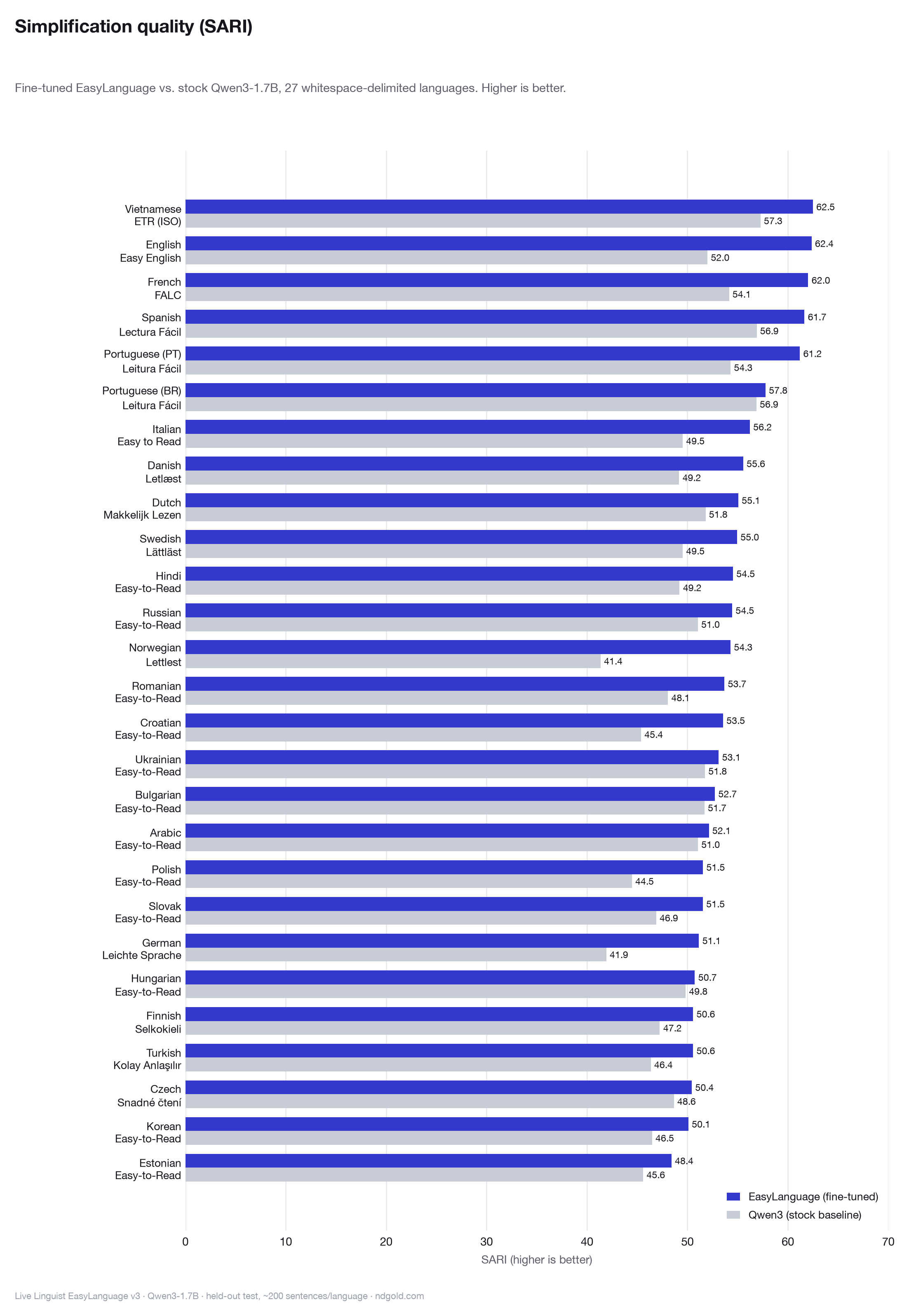
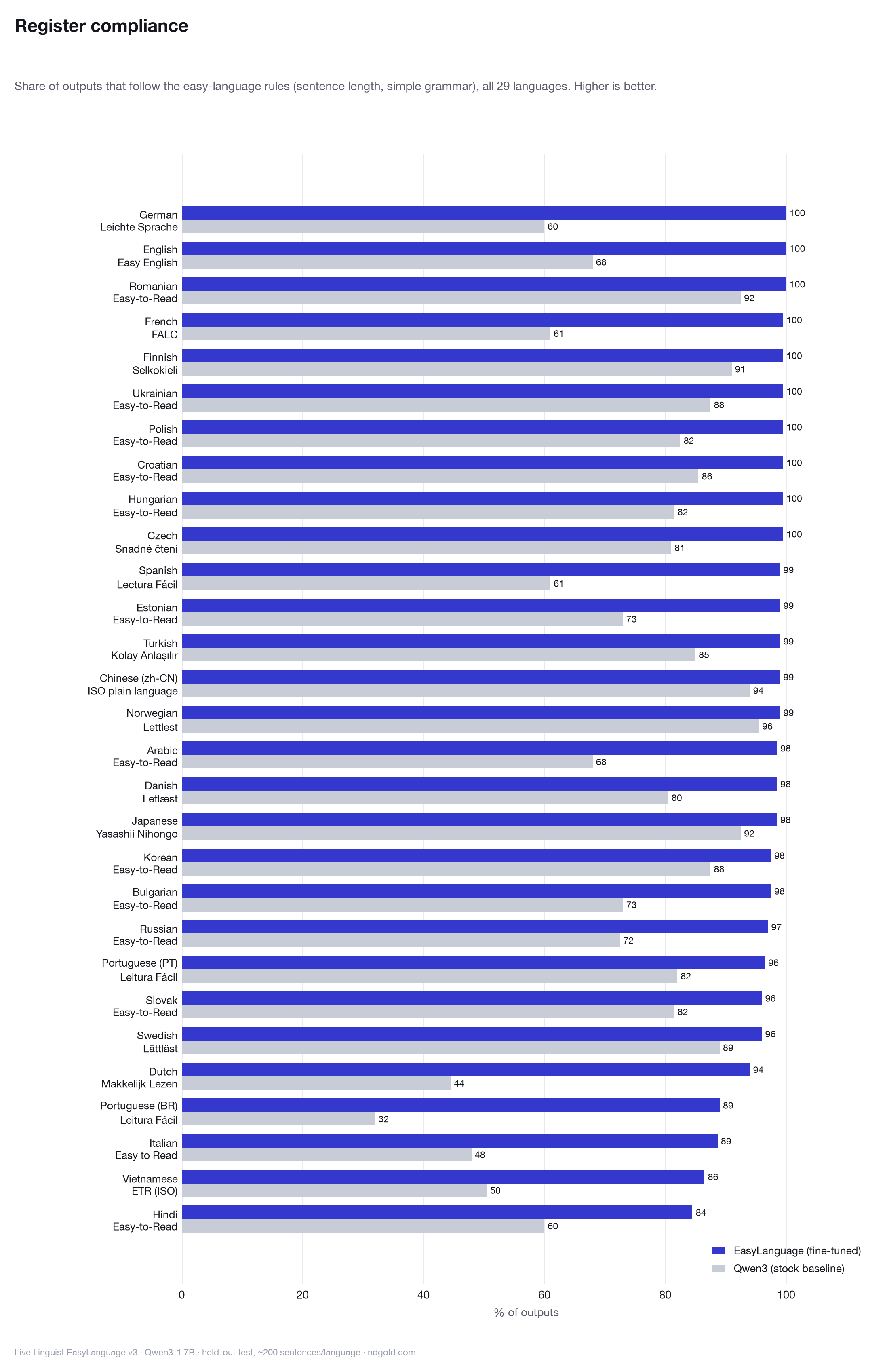
Mean SARI 54.6 vs 49.6 stock · mean compliance 97% vs 74% · the 1.7B fine-tune beats the 0.6B fine-tune on SARI in all 27 whitespace-delimited languages.
Every language
We report fine-tuned (ft) and stock Qwen3 results with greedy decoding on about 200 held-out sentences per language. SARI appears for both sizes; chrF, register compliance, and language ID appear for the 1.7B model. Higher is better in every column.
What SARI measures
SARI compares a model’s simplified sentence with a reference easy-language version. It gives credit for words the model kept, added, or deleted in the right places, and it penalizes changes that break the match. Scores run from 0 to 100, and higher is better. The number is not a percentage, and the absolute score depends on the test set, so read the gap between models on the same rows. The 0.6B fine-tune averages 52.7 against 37.7 for stock Qwen3, a 15-point gap. The 1.7B fine-tune averages 54.6 against 49.6, a 5-point gap. Those gaps mean the fine-tuned output lands closer to the reference easy-language rewrites. The compliance column shows the other half of the result: the 0.6B fine-tune follows the register rules in 94% of outputs, against 29% for stock.
| Language | 0.6B SARIft / stock | 1.7B SARIft / stock | 1.7B chrFft / stock | 1.7B complianceft / stock | 1.7B LIDft |
|---|---|---|---|---|---|
| VietnameseETR / ISO plain language | 60.2 / 41.3 | 62.5 / 57.3 | 60.9 / 54.6 | 87% / 51% | 100% |
| EnglishEasy / Plain English | 61.0 / 32.5 | 62.4 / 52.0 | 57.1 / 42.7 | 100% / 68% | 100% |
| FrenchFALC | 58.0 / 33.3 | 62.0 / 54.1 | 55.6 / 45.9 | 100% / 61% | 100% |
| SpanishLectura Fácil | 59.5 / 36.6 | 61.7 / 56.9 | 57.8 / 51.4 | 99% / 61% | 100% |
| Portuguese (PT)Leitura Fácil | 58.2 / 39.0 | 61.2 / 54.3 | 61.0 / 51.8 | 97% / 82% | 100% |
| Portuguese (BR)Leitura Fácil | 55.3 / 37.5 | 57.8 / 56.9 | 54.0 / 49.7 | 89% / 32% | 100% |
| ItalianEasy to Read | 54.0 / 49.2 | 56.2 / 49.5 | 51.9 / 40.6 | 89% / 48% | 100% |
| DanishLetlæst | 53.7 / 35.6 | 55.6 / 49.2 | 52.8 / 42.1 | 99% / 81% | 100% |
| DutchMakkelijk Lezen | 51.7 / 39.0 | 55.1 / 51.8 | 51.4 / 46.4 | 94% / 45% | 99% |
| SwedishLättläst | 53.6 / 40.2 | 55.0 / 49.5 | 57.9 / 48.2 | 96% / 89% | 98% |
| HindiEasy-to-Read | 51.9 / 35.2 | 54.5 / 49.2 | 47.6 / 40.2 | 85% / 60% | 98% |
| RussianEasy-to-Read | 51.1 / 41.1 | 54.5 / 51.0 | 51.5 / 43.7 | 97% / 73% | 100% |
| Norwegian (Bokmål)Lettlest | 51.8 / 30.0 | 54.3 / 41.4 | 56.2 / 38.1 | 99% / 96% | 100% |
| RomanianEasy-to-Read | 51.7 / 40.8 | 53.7 / 48.1 | 52.9 / 41.5 | 100% / 93% | 100% |
| CroatianEasy-to-Read | 51.3 / 33.9 | 53.5 / 45.4 | 54.5 / 42.6 | 100% / 86% | 100% |
| UkrainianEasy-to-Read | 52.1 / 39.6 | 53.1 / 51.8 | 54.8 / 51.4 | 100% / 88% | 100% |
| BulgarianEasy-to-Read | 50.8 / 34.2 | 52.7 / 51.7 | 55.0 / 52.5 | 98% / 73% | 99% |
| ArabicEasy-to-Read (RTL) | 50.0 / 50.1 | 52.1 / 51.0 | 50.5 / 46.3 | 99% / 68% | 100% |
| PolishEasy-to-Read | 50.6 / 36.9 | 51.5 / 44.5 | 49.8 / 36.6 | 100% / 83% | 100% |
| SlovakEasy-to-Read | 51.2 / 40.6 | 51.5 / 46.9 | 47.7 / 40.3 | 96% / 82% | 100% |
| GermanLeichte Sprache | 47.6 / 33.0 | 51.1 / 41.9 | 46.6 / 31.1 | 100% / 60% | 100% |
| HungarianEasy-to-Read | 49.7 / 38.6 | 50.7 / 49.8 | 52.3 / 50.0 | 100% / 82% | 100% |
| FinnishSelkokieli | 49.9 / 35.2 | 50.6 / 47.3 | 56.0 / 48.8 | 100% / 91% | 100% |
| TurkishKolay Anlaşılır | 50.5 / 31.7 | 50.6 / 46.4 | 50.6 / 44.3 | 99% / 85% | 100% |
| CzechSnadné čtení | 49.4 / 39.5 | 50.4 / 48.6 | 49.2 / 45.9 | 100% / 81% | 100% |
| KoreanEasy-to-Read | 49.2 / 43.8 | 50.1 / 46.5 | 42.9 / 33.7 | 98% / 88% | 100% |
| EstonianEasy-to-Read | 47.6 / 30.5 | 48.4 / 45.6 | 50.7 / 45.5 | 99% / 73% | 100% |
| Chinese (zh-CN)ISO plain language | n/a | n/a | 53.9 / 41.6 | 99% / 94% | 100% |
| JapaneseYasashii Nihongo | n/a | n/a | 45.5 / 38.8 | 99% / 93% | 100% |
SARI
Simplification quality (Xu et al., 2016): a single score for words kept, added, and deleted relative to references.
chrF
Character n-gram F-score (Popović, 2015). It helps where whitespace tokenization fails, as it does for Japanese and Chinese.
Compliance
The share of outputs that pass the target register’s deterministic validators: sentence caps, simple grammar, anchoring, numbers, anti-parroting.
LID / parrot
LID is the share of outputs that stay in the target language. Parrot is the share that copies the input or a prompt example instead of rewriting.
Notes. Arabic ships on the 1.7B quality model, where it clears stock on SARI, compliance, and LID. At 0.6B its SARI sits level with stock. Japanese and Simplified Chinese ship on chrF, compliance, and LID because whitespace tokenization makes SARI meaningless for those scripts. Compliance and LID are validator rates, not human judgments.
On-device
The 0.6B model simplifies a caption segment inside the streaming budget on a phone or laptop. The 1.7B model gives the quality option for recorded material, offline work, and slower conversations. Both 4-bit MLX artifacts fit in local memory and need no network call.
4-bit MLX, live model
4-bit MLX, quality model
M1, M2, M3, A18 Pro
Inference stays local
A note on speed numbers
We publish model size and device coverage. We do not publish tokens-per-second figures we have not verified. Latency depends on the speech segment, the speech-recognition front end, and the device. The live-caption claim rests on the architecture: the small model is the one built to keep up, and the pipeline does not wait on a server round trip.
The dataset
The run-3 dataset holds about 74,000 supervised pairs across 29 locales (73,972 train), with about 200 held-out test sentences per language. German pairs come from German4All. We generated the remaining spoken-style pairs with a teacher model and checked their quality.
Every pair passed the same deterministic validators the app uses at runtime: sentence-length caps, simple-grammar checks, source anchoring, number fidelity, anti-parroting, and a wrong-language guard. The training signal reflects the register rules, so the model learns more than “shorter text.”
Limitations
Use, citation & ownership
Dylan Goldblatt created Live Linguist’s free software, open-source datasets, and open-source models for educational purposes. They support language learners, educators, accessibility teams, and researchers. They do not replace a certified accessibility service, a medical device, or human easy-language review.
If you use the project in teaching, research, or a published build, attribute Dylan Goldblatt. The samples below cover the usual style guides; update the version and year when you cite a later release. For the models and dataset, cite the Hugging Face repository you used.
APA 7
Goldblatt, D. (2026). Live Linguist: On-device easy-language caption simplification (Version 3) [Computer software]. https://ndgold.com/live-linguist/
MLA 9
Goldblatt, Dylan. Live Linguist: On-Device Easy-Language Caption Simplification. Version 3, ndgold.com, 2026, ndgold.com/live-linguist/.
Chicago 17
Goldblatt, Dylan. Live Linguist: On-Device Easy-Language Caption Simplification. Version 3. Computer software. 2026. https://ndgold.com/live-linguist/.
IEEE
D. Goldblatt, "Live Linguist: On-device easy-language caption simplification," Version 3, 2026. [Online]. Available: https://ndgold.com/live-linguist/
BibTeX: project
@software{goldblatt2026livelinguist,
  author  = {Goldblatt, Dylan},
  title   = {Live Linguist: On-Device Easy-Language Caption Simplification},
  year    = {2026},
  version = {3},
  url     = {https://ndgold.com/live-linguist/},
  note    = {Open models and datasets for 29 easy-language locales}
}
BibTeX: quality model
@misc{goldblatt2026easylanguage,
  author    = {Goldblatt, Dylan},
  title     = {Qwen3-1.7B-EasyLanguage-4bit},
  year      = {2026},
  publisher = {Hugging Face},
  url       = {https://huggingface.co/ndgold/Qwen3-1.7B-EasyLanguage-4bit}
}
Ownership
Aquilops LLC holds the sole intellectual property in the closed-source applications. They cost nothing, and their source stays closed. © 2026 Aquilops LLC. All rights reserved.
The open models and datasets carry their own licenses: Apache-2.0 for the models, CC BY-SA 4.0 for the dataset. The Qwen3 base model and German4All source data keep their upstream licenses. Aquilops LLC owns the closed-source application, its name, and its icon.